I got most of this education at the Elk Store in Elk, which isn’t where I expected to learn about Pinot Noir.
That’s the thing about a store that has been the middle of its town since 1927 — you end up in conversations there. That’s how I met Claire Baxter, who runs the tasting room in Philo with her husband Phillip, and who was generous with a cook asking a lot of questions about what was actually in the bottle. Most of what follows I owe to her.
Here’s why it mattered to me. We source everything else by name — the farms, the ranchers, the foragers, the boats. It never made sense that wine would be the one thing on the table nobody could account for.
So this is the first in a series on the wineries whose bottles end up on our tables, and why. We’re starting with Baxter.
The fog does the work
Anderson Valley runs about fifteen miles, northwest to southeast, and it opens to the ocean along the Navarro River. That gap is the whole story. Cold marine air funnels up the corridor every evening, thinning as it pushes inland toward Boonville.
Here’s what that does. A grape builds sugar during warm daylight and burns off acid around the clock — and heat speeds up both. Anderson Valley gets genuinely hot summer afternoons, which ripens the fruit, and then the temperature falls forty to fifty degrees overnight, which stops the acid loss cold. It’s one of the widest day-to-night swings of any wine region on earth. The grape gets weeks of extra hang time to build flavor while the acid stays intact.
Ripe and tart. That combination is rare, and it’s the reason this valley grows Pinot Noir the way it does.
It’s also the reason the wines work with our food. Acid is what cuts fat, resets the palate between bites, and stands up to a squeeze of lemon or a sharp vinaigrette without going flat. Low-acid wine dies next to good cooking. These don’t.
If you’ve cooked on this coast you already know the mechanism from the other side. It’s the same fog that makes the brassicas sweet and keeps the lettuces from bolting in July. The valley and the coast are running the same weather; one of them turns it into dinner and the other turns it into wine.
Baxter Winery, Philo
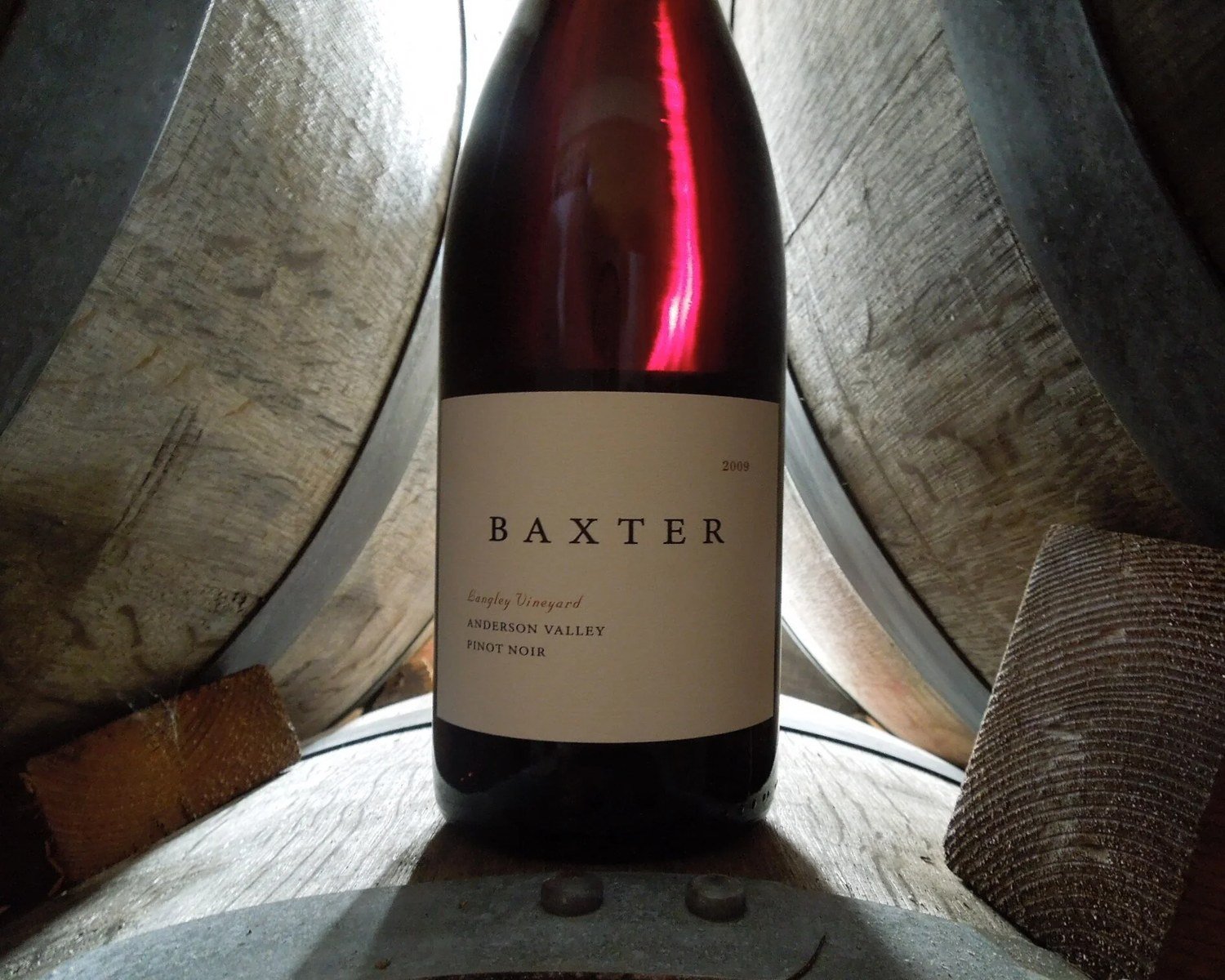
Baxter began in 2002, when Phil L Baxter and Phil T G Baxter — father and son, both winemakers by training and trade, with something like fifty years between them — decided to work together. The tasting room on Highway 128 opened in 2014, and Phillip runs it with Claire, whom he met when they were both studying in Grenoble.
Baxter is really two places, and this is worth getting straight because almost nobody does. The tasting room is in Philo, in the valley. The estate is up on Greenwood Ridge, above Elk, about five miles from the Pacific — a twenty-minute climb away and a different appellation entirely.
That ridge is the Mendocino Ridge AVA, and it’s the strangest appellation in the country: the only non-contiguous one in America. Only land at or above 1,200 feet qualifies, so the appellation is a scatter of hilltops rather than a shape you could draw a fence around — roughly two percent of the ground it’s drawn over. They call it islands in the sky, because on a foggy morning that’s exactly what it looks like from up there: peaks standing out of a white sea with the whole valley drowned underneath.
They farm organically, partly certified, and buy fruit from a small set of vineyards they have worked with long enough to know by heart — a number of them old plantings, some ungrafted. Total production runs around two thousand cases a year across the whole range.
What happens in the cellar is the part worth understanding, because you can taste every decision:
- Hand-harvested, then a five-day cold soak. The fruit sits chilled with its skins before fermentation starts, pulling color and aroma without pulling tannin.
- Wild yeast. Nothing added. Fermentation starts with whatever rode in on the fruit and lives in the cellar — slower, less predictable, and particular to that place in a way a packet of commercial yeast can never be.
- Punch-downs by hand. Twice a day, through the whole ferment. It’s physical work, and it’s gentler than pumping wine over the cap. Gentler means less harsh tannin.
- Partial whole-cluster. Some fruit goes in with the stems still on. Stems bring structure, a turn of black pepper, and a green-tea lift on the finish.
- Basket press. The old way. Slow, and easy on the fruit.
- One hundred percent neutral French oak. This is the one that matters most, and it costs them something. A new barrel runs well over a thousand dollars and hands you vanilla, toast and baking spice — flavors that come from the barrel, not the vineyard. Baxter uses only older barrels that have already given up their flavor. The wine goes in, ages a long time, and comes out tasting like fruit and site instead of like woodwork.
They bottle unfined and unfiltered, which is why you’ll sometimes find a little sediment. That’s not a flaw. Filtering strips texture along with the particles, and they would rather keep the texture. Stand the bottle up a day ahead if it bothers you.
Why we pour it
We cook seasonally, which means the menu moves and the wine has to move with it. Baxter’s Pinot does.
The savory register is the practical reason. These wines run toward cranberry, pomegranate, forest floor and dried herb rather than jam. That means they sit down happily next to mushrooms, roasted alliums, nettles, and anything that came out of the woods without a fight. Duck. Grilled king salmon in summer. Pork shoulder in the fall. A pot of beans with good olive oil and a lot of black pepper.
Low tannin is the second reason. Pinot’s skins are thin, so there’s very little grip — which means it doesn’t punish delicate food or pick a fight with a dish that already has salt, acid or a little heat in it. A big tannic red has exactly one job. Pinot has twenty.
And the scale is right. These are small-lot wines from named vineyards, made a few hundred cases at a time. Nobody at your table has had them before, which is worth more at a dinner than a label anyone would recognize.
Baxter also makes Chardonnay, Syrah and Carignane, which gives a dinner somewhere to go across four or five courses without ever leaving one producer or one valley.
Twenty minutes inland
There’s a habit on this coast of treating the ocean and the valley as separate places. Same county, same fog, one road between them.
When we build a pairing for a private dinner we’re usually working inside a thirty-mile radius: fish that came off a boat in Fort Bragg, vegetables from a farm in the valley, bread from a neighbor, and wine from a family in Philo who pressed it by hand. That’s not a marketing position. It’s just what’s here, and it’s better than anything we could truck in. If you want the seasonal half of that picture, it’s in our guide to what’s actually in season, Point Arena to Ten Mile.
If you want to go
The tasting room is at 8660 Highway 128 in Philo, across from Lemons Market. Hours are seasonal — Thursday through Sunday in summer, Friday through Sunday from November — and tastings are seated and by reservation, with booking closing late morning on the day. This isn’t a place to turn up on a whim at three o’clock. Book it the night before and give it an unhurried afternoon.
It’s also dog friendly, which on this coast is never a small thing. Willow approves.
One last thing, for anyone who likes a map to make sense. The road that climbs from Philo over the ridge and down to the coast is called Philo Greenwood Road — because Elk was called Greenwood until the town needed a post office and found that California already had one. The ridge kept the old name. So Baxter’s estate and the road to it are both named for a town that has not been called that in over a century.
And a note on addresses, since this confuses people: a fair few wineries turn up listed under Elk on the strength of a ridge parcel. The one that’s properly in Elk is Drew, at the coastal end of that same Philo Greenwood Road — the only estate winery in the Mendocino Ridge AVA, sitting at 1,250 feet about three miles from the ocean, which makes it the westernmost vineyard in Mendocino County. They’re a subject for another day.
Mendocino Chef offers wine pairings with private dinners on request. If you would like a menu built around Anderson Valley bottles — or you’re curious what else we’d pour — tell us about your date and we’ll come back with a plan.
Next in this series: the Alsatian whites of Anderson Valley, and why Gewürztraminer is the most underrated bottle on the coast.
Bottle photograph courtesy of Baxter Winery. Thanks to Claire Baxter for the education.
Mendocino Chef
We cook this food for a living — in your home, your vacation rental, or wherever you are staying on the coast.
Private dinners, small weddings, rehearsal dinners and retreat catering from Point Arena to Ten Mile and inland through Anderson Valley.